1. What Is a Clinical Program at MedCerts?
Clinical programs are training pathways that combine online coursework with hands-on clinical hours. These in-person hours are often required for certification. Typically, you complete them after your coursework or alongside, if the program allows it.
During your clinicals, you apply what you’ve learned in your MedCerts program under the supervision of healthcare professionals. Requirements vary by program and credential. If you’re passionate about hands-on care, there’s a good chance you might have clinical requirements. These clinicals are especially important for tasks like drawing blood, placing EKG wires or sterilizing surgical equipment.
2. Which MedCerts Programs Include Clinical Requirements
MedCerts’ program catalog has multiple healthcare pathways that require clinicals. Each clinical program has unique requirements and expectations. So, head to the course’s Clinical Requirements tab on each website Program page to see what’s needed.

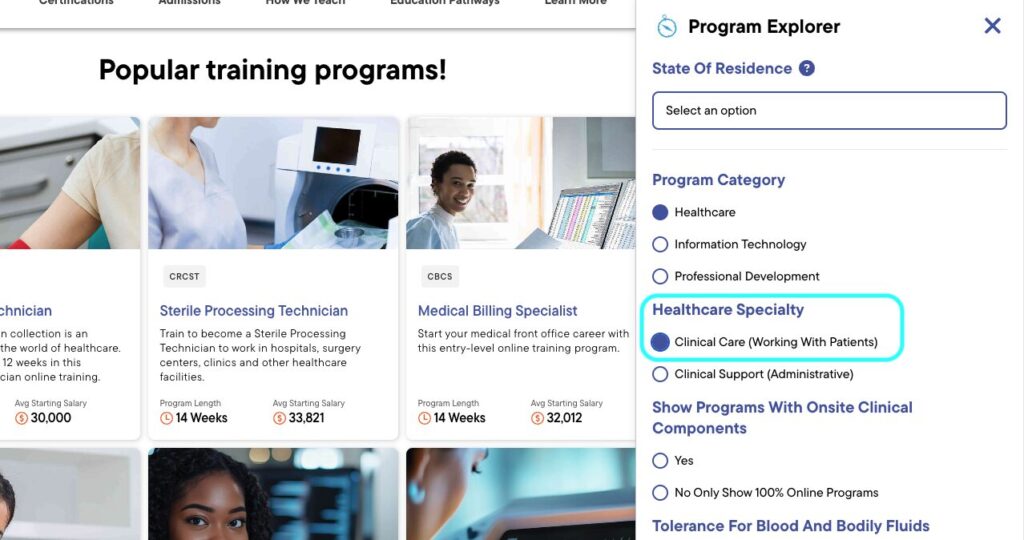
You can also sort through our programs with clinical requirements using our Program Explorer.
Here are a few programs with clinical components:
- Phlebotomy Technician: Within 90 days of the CPT exam, you’ll perform 30 live venipunctures and 10 capillary sticks.
- Behavioral Technician Specialist: Meet the 40-hour training requirement, complete an on-the-job competency assessment and apply to the Behavior Analyst Certification Board.
- Sterile Processing Technician: Within 180 days, you’ll perform 400 hours of in-person experience at a Central Services department.
- EKG Technician: You’ll complete 10 live EKGs within 90 days of the CET exam.
3. Understanding Your Responsibility in Securing a Clinical Site
Many credentialing processes have time limits for completing clinicals. So, it’s important to start searching for a site early. It’s your responsibility to secure the site and connect with its personnel to coordinate completing your clinicals.
MedCerts’ team of Career Coaches can help you strategize possible clinical sites once you’ve completed 75% of your program. But they can’t guarantee clinical placement or search for sites on your behalf. For the best success, start strong by researching and contacting local opportunities like clinics, labs or hospitals before enrolling in a MedCerts clinical program. You can also use professional connections or job sites like LinkedIn to network and connect with department managers.
4. How MedCerts Supports Students Through the Clinical Process
Connect with MedCerts’ friendly Career Coaches for tools and guidance. Our support team helps you prepare for your clinicals and navigate the search with confidence. Among other benefits, they offer:
- Program-specific clinical handbooks
- Recorded webinars and videos in the Clinical Toolbox
- Best practice for identifying site searches and reaching out to clinical teams
5. What the Clinical Experience Is Like
Your clinical experience depends on the setting and role, but each is designed to prove your knowledge with real-world applications. During your clinical hours, you might:
- Work with other healthcare professionals
- Follow facility schedules and protocols
- Submit documentation requirements
- Practice hands-on skills you learned at MedCerts
6. Is a Clinical Program the Right Fit for You?
Clinical programs come with extra certification requirements. To check your fit, try completing a self-assessment.
Ask yourself:
- Are you comfortable working in busy healthcare environments?
- Can you make time for hands-on training in addition to coursework?
- How far are you able to travel if there are no convenient locations that can sponsor your clinicals?
- Are you proactive and organized when coordinating schedules and requirements?
Launch Your Career With MedCerts Training
Healthcare roles are widely in demand, and high-quality training with clinicals can set you apart as a strong job candidate with experience and set you up for career success. Check out our clinical programs, and get started today!